Our Source Tier System
How we build your trust: every number, price, and verdict on this site is tagged by where it came from — so you can see how much weight to give it. No hidden sources. No borrowed authority.
AICreatorGear is a research and decision hub for AI creation tools and creator hardware. We help you choose between Runway and Pika, ElevenLabs and Murf, Rode and Elgato — without you having to test 40 tools yourself.
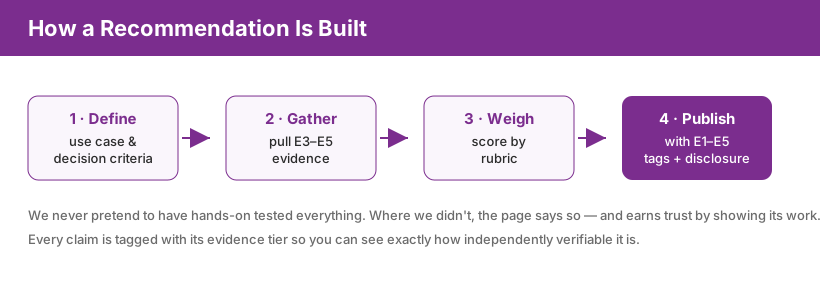
We do that by collecting the best available evidence, checking it against the source, and applying our own production expertise. This page explains exactly how we do it, and how to read any claim on the site.
The 10-second version
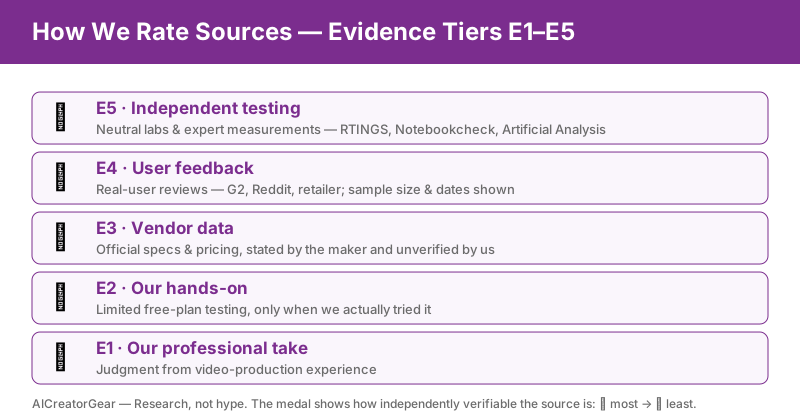
Every article that recommends, compares, or ranks a tool carries four source marks. Here is what they mean:
Independent testing — labs & expert reviews · User feedback — aggregated, sample sizes shown · Vendor data — official specs & pricing (unverified) · Our hands-on testing — E2a limited free-plan trials · E2b manufacturer-provided sample, editor-tested (E2) · Our professional take — analysis from real production experience
When you see a next to a price, it is the vendor’s stated price (and we mark it unverified). When you see a next to a measurement, it is a lab or expert result. You never have to wonder where a claim came from.
Why we show our work
Most “review” sites hide their method. They paste a verdict and hope you trust it.
We take the opposite approach. We believe a claim is only as good as its source, so we label the source on every page. Three reasons this matters to you:
- You can verify anything. Every specific claim links back to where we found it — an official pricing page, a lab measurement, or a user-review aggregate.
- You see the confidence level. A independent measurement and a vendor claim are not the same weight. We make that distinction visible instead of blurring it.
- Conflicts are shown, not buried. When a vendor says one thing and testers or users say another, we put the disagreement on the table. That is more useful than a tidy lie.
This is also how we stay on the right side of disclosure law (FTC) and search-quality guidelines: transparent research, original analysis, and clearly labeled sources — never fabricated first-hand experience.
The five source tiers
Our “source tier” is the credibility language used across the entire site. One tool, one claim, one mark.
| Mark | Tier | What it is | Evidence level | What you should read it as |
|---|---|---|---|---|
| Independent testing | RTINGS, Notebookcheck, Artificial Analysis, independent reviewers | E5 | “This is what a third-party lab or expert measured — the most verified weight.” | |
| User feedback | G2, Capterra, Reddit, Amazon reviews, social feedback | E4 | “This is what real users reported — both praise and complaints.” | |
| Vendor data | Official site, pricing page, changelog, API docs, official YouTube, affiliate media kit | E3 | “This is what the company itself states about features, price, and limits — unverified by us.” | |
| Our hands-on testing — E2a (free plan) | When we sign up for a free/trial plan and try it ourselves (limited, not a paid review) | E2a | “This is what we observed hands-on on a free plan — limited use, not a full test.” | |
| Our hands-on testing — E2b (manufacturer sample) | When a manufacturer provides a unit for testing, our editors test it independently; the vendor sees the draft only to correct facts, never to change a verdict | E2b | “This is what we measured on a provided sample — verified by us, conclusion not influenced by the vendor.” | |
| Our professional take | Production-workflow analysis from real industry experience | E1 | “This is our editor’s expert perspective on fit and workflow.” |
The medal is a trust signal, and the E-number is the credibility rank. Gold = most independently verifiable (expert testing, E5) → Silver = real user voices (E4) → Bronze = vendor’s own claims (E3), which we always mark unverified. Higher E-number = higher credibility. Note: vendor data (E3) is still the authoritative source for prices, specs, and changelogs — but it is the maker’s own wording and unverified by us, so it sits lowest and is labeled accordingly.
The rules we never break
- is for facts only — features, prices, limits. We always add “vendor-stated, unverified by us” where we have not confirmed it ourselves.
- shows both sides — we report praise and complaints, with sample size and date range.
- is for verification — we cite the data point and link the source; we never copy another site’s conclusions as our own.
- is clearly opinion — labeled as professional analysis, never dressed up as a test result.
- appears only when we tried it — we add it only when we actually tried the tool on a free plan, and always mark it as limited hands-on, never a full paid review.
- When tiers disagree, we show the gap — never pick one side to make a product look better.
How we score tools
Rankings on AICreatorGear are driven by a single, transparent rubric — not by commission rates. (That is a hard rule: ranking by payout is deceptive and illegal under FTC guidance.)
For AI software, our default weighting is:
| Dimension | Weight | What it measures | Primary tier |
|---|---|---|---|
| Price fairness | 20% | Value relative to what you get; free-tier generosity | + |
| Feature depth | 20% | Breadth and usefulness of capabilities | |
| Output quality | 20% | Real-world result quality (per lab/user data) | + |
| Ease of use | 15% | Learning curve for a working creator | + |
| Commercial rights | 10% | Can you use outputs in client or monetized work? | |
| Support | 5% | Responsiveness and docs | |
| Community sentiment | 10% | Aggregate user mood over time |
How a score is built: every sub-score cites its source. If we say a tool scores 8/10 on output quality, the page shows why — the lab measurement or user consensus behind it. A score with no cited basis does not get published. Hardware categories use a similar rubric adapted to specs, measurement data, and workflow fit.
We may adjust weights per category (a mic rubric weights “sound profile” higher than “price”). The principle never changes: weights are published, sources are cited, and commission never decides rank.
When sources disagree
This happens more than vendors would like. Examples we have already documented:
- A vendor’s blog advertises a generous free tier; independent reviewers report a much smaller one. → We show both and tell you to confirm at sign-up.
- A spec sheet claims 10 hours of battery; a lab measures 8. → We cite the lab and flag the gap.
- Marketing says “studio quality”; user reviews describe a persistent noise floor. → Both sides are quoted.
Our policy: surface the conflict, cite each side, and let you decide. We never quietly pick the version that flatters a product.
Sources we cite (and link to)
Our tiers are only as good as the sources behind them. We link directly to primary and authoritative references, including:
- Vendor sources — official product, pricing, and changelog pages (Runway, Pika, Kling, Luma, ElevenLabs, Murf, Synthesia, HeyGen, and others).
- Independent labs & benchmarks — Artificial Analysis, RTINGS, Notebookcheck.
- User-feedback aggregators — G2, Capterra, Reddit.
- Our own price tracker — monthly, dated snapshots of ElevenLabs and other pricing.
We also publish an llms.txt file at our site root that maps our most useful pages for AI assistants — part of how we make our research machine-readable.
Affiliate disclosure
Some links on AICreatorGear are affiliate links. If you buy through them, we may earn a commission at no extra cost to you.
This never affects our analysis, our scores, or our rankings. Our rubric is commission-blind by design, and our source tiers make that visible. For the full legal text, see our Disclosure page.
Frequently asked questions
Do you test every product yourself?
We research every tool from verifiable public sources — official specs, independent labs, and aggregated user feedback — and apply our production expertise to interpret them. Every claim on the site is tagged with its source tier so you can see exactly where it came from. Occasionally we also sign up for a tool’s free plan to add limited hands-on notes; these are always tagged as our own first-hand testing (E2), clearly marked as free-tier / limited use, and never presented as a paid review.
Why should I trust your “professional take” ()?
Our editor brings real video-production and post-production experience. The mark is always labeled as expert opinion, not a test result, and it is one input among vendor, user, and expert evidence — never the only one.
How do you choose what to recommend?
By our published rubric (see above), which is commission-blind. We rank on price fairness, feature depth, output quality, ease of use, commercial rights, support, and community sentiment — with sources cited for every sub-score.
What if a price or feature changes after you publish?
Vendor pages change often. We date-stamp vendor claims (e.g., “vendor-stated, Aug 2026”) and revisit high-traffic pages on a schedule. If you spot something stale, our contact page gets it fixed.
Are your reviews biased toward paying affiliates?
No. Our ranking method is explicitly commission-blind, and our source-tier system makes the evidence behind every claim visible. We also cover free and low-cost options in every category.
About the editor
AICreatorGear is run by a working video-production professional who has spent years behind the edit — scripting, recording, color-grading, and shipping content. That background is why our comparisons focus on workflow fit, not just feature checklists: a tool’s spec sheet rarely tells you whether it will survive contact with a real deadline.
You can read more on our About page and meet the editor on the Authors page.
Last reviewed: 2026-08-15. We update this methodology as our process improves.